Guide
Best Car for DoorDash and Delivery: City Driving Changes the Ranking
What DoorDash asks of the car
Almost nothing. DoorDash’s own requirements page says it plainly: “There are no car year requirements.” A little further down: “Any make, model, or year is acceptable as long as you have a valid driver’s license and insurance.” You need a license, proof of insurance and the vehicle registration to sign up, and your own policy has to meet your state’s minimum. DoorDash’s coverage only applies while you are on an active delivery. The rideshare insurance guide goes through why that gap matters.
Uber is stricter. Its vehicle list checks a minimum model year that moves forward over time (the Uber tier guide has the details), so an old car can age out of Uber X while still being fine for DoorDash. That opens up cheaper, older cars for delivery. One limit worth knowing: the prices below cover only the model years this site tracks for each car. For anything older, this site has no numbers.
Delivery is city driving, and that changes the fuel math
Every cost figure elsewhere on this site uses the EPA combined rating, which blends city and highway driving. That fits a rideshare shift reasonably well, since airport runs and cross-town trips put real highway miles on a car. Food delivery mostly doesn’t. It’s short hops between restaurants and houses, lots of stopping, lots of low-speed crawling through parking lots.
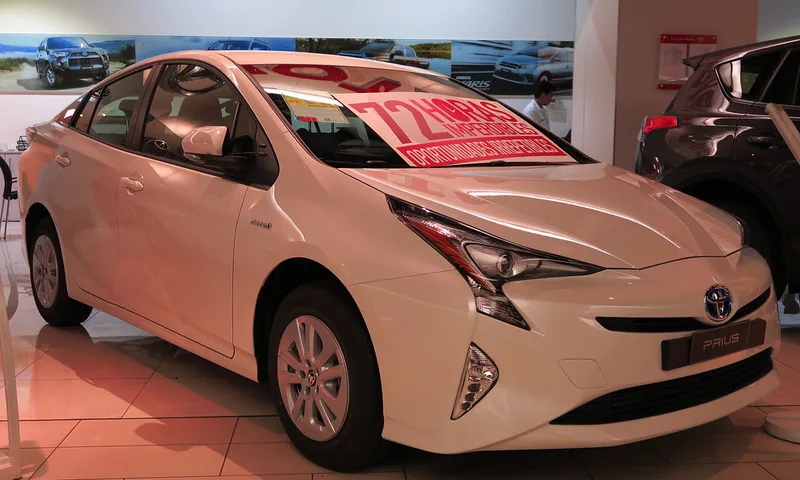
The EPA publishes the city number separately, and the cars on this site split in two when you look at it. The hybrids hold steady or do better in town. The Prius goes from 52 mpg combined to 54 city, the Corolla Hybrid from 52 to 53, the Niro from 49 to 51. The two gas cars go the other way: the Civic drops from 35 to 31, and the Odyssey from 22 to 19.
At 30,000 miles a year and $4.085 a gallon, that moves the annual fuel bill quite a bit. On the combined rating a Prius spends $1,144 a year less on gas than a Civic. On the city rating the gap is $1,684: $2,269 for the Prius against $3,953 for the Civic.
A fair caveat: the EPA city test is a standard driving cycle, not a recording of anyone’s delivery shift, and your own mileage will differ. It’s still a closer fit for delivery than the combined figure. Hybrids do well on it for a simple reason: they recover energy every time they brake, and town driving is mostly braking.
The twelve cars, ranked for town driving
Here is every car on this site with the city fuel figure swapped in. Maintenance and depreciation are the same per-mile numbers used everywhere else on the site; only the fuel column changes.
| Vehicle | City mpg | Fuel per mile in town | Cost per mile in town | Used price from |
|---|---|---|---|---|
| Bolt EV | EV | 5.2c | 18.0c | $8,587 |
| Prius | 54 | 7.6c | 20.1c | $11,360 |
| Model 3 | EV | 4.3c | 20.7c | $17,200 |
| Accord Hybrid | 48 | 8.5c | 22.6c | $13,250 |
| Camry Hybrid | 51 | 8.0c | 22.9c | $13,290 |
| Niro | 51 | 8.0c | 24.0c | $8,093 |
| Sonata Hybrid | 45 | 9.1c | 26.1c | $12,280 |
| Corolla Hybrid | 53 | 7.7c | 26.3c | $13,360 |
| Civic | 31 | 13.2c | 28.8c | $16,170 |
| RAV4 Hybrid | 41 | 10.0c | 29.3c | $18,160 |
| Sienna | 36 | 11.3c | 38.4c | $27,590 |
| Odyssey | 19 | 21.5c | 45.8c | $14,228 |
The two electric cars have no separate city figure in this site’s data, so their row uses the same electricity cost as everywhere else, at the residential rate. “Used price from” is the bottom of the price range this site tracks.
The Odyssey is the one to avoid. It already costs the most per mile to run on the combined rating, and in town it gets worse, to 45.8 cents a mile. That is more than twice the Prius.
What stops mattering when there are no passengers
A few of the things that make a car good for Uber don’t count for anything here.
The Comfort tier is the big one. The Model 3, Camry Hybrid and Accord Hybrid are the only cars on this site that qualify for Uber Comfort, and for a rideshare driver that’s a real reason to pick one of them. DoorDash pays the same for a burrito delivered in a Model 3 as in a Prius. Without that, the Model 3 just looks like a more expensive Prius: 20.7 cents a mile against 20.1, and $5,840 more at the bottom of the used price range.
Rear legroom drops out too, since the back seat will hold a food bag at most. Trunk space barely matters for food. The smallest trunk on this site is the Corolla Hybrid’s at 13.1 cubic feet, which holds a couple of insulated bags without trouble. It matters more if you also do grocery orders, where the Prius hatchback (27.4 cubic feet) or the RAV4 Hybrid (37.6) are the practical picks.
The Bolt EV, if you can charge at home
On paper the Bolt EV is the cheapest car on this site for any kind of driving, at 18.0 cents a mile, and it’s also one of the cheapest to buy. Two things behind that number are worth knowing before you commit.
First, the electricity price is a home rate. If you charge at public fast chargers, you will pay more per kilowatt-hour, and the Bolt’s lead shrinks. The hybrid or electric guide works out the price at which it disappears.
Second, the time spent charging isn’t counted anywhere in these numbers. For a driver who charges overnight at home, that’s close to zero. For one who needs a top-up in the middle of a dinner rush, it’s lost orders. The charging downtime guide covers what this site can and can’t say about that.
So which one?
For most delivery drivers, the Prius. It’s the cheapest gas-burning car on this site in town, it’s reasonably cheap to buy used, and its hatch is the biggest of any car here that isn’t an SUV or a minivan.
If the budget is tight, look at the Niro. It starts at $8,093, the lowest price on this site, and runs 24.0 cents a mile in town.
With a driveway and a charger, the Bolt EV beats both on running cost.
The two to skip for delivery are the Civic and the Odyssey. Both lose more in town than anything else here, and neither has an advantage that DoorDash pays for.