Comparison
Camry Hybrid vs Corolla Hybrid: The Answer Depends on Your Budget
Camry Hybrid for anyone shopping the bottom of the used market, where it is both $70 cheaper to buy and $1,110 a year cheaper to run. Corolla Hybrid only at the top, where its $5,890 discount outlives the car.
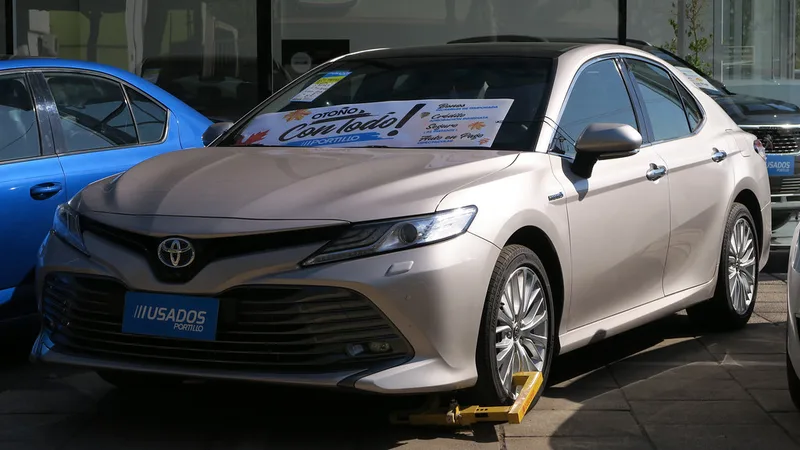
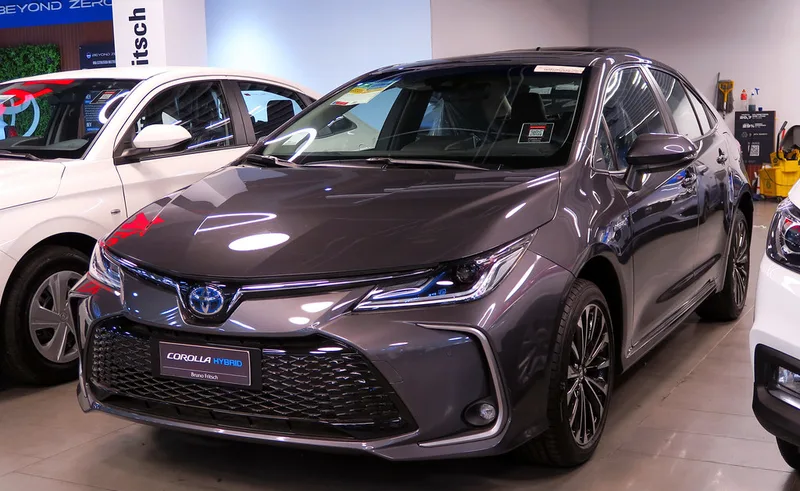
- Energy 7.9¢/mi
- Maintenance 2.9¢/mi
- Depreciation 12.0¢/mi
- Energy 7.9¢/mi
- Maintenance 2.4¢/mi
- Depreciation 16.2¢/mi
Energy, maintenance and depreciation only, at $4.08/gal. Insurance, registration and any car payment sit on top. Add yours in the cost per mile calculator.
| Spec | Toyota Camry Hybrid | Toyota Corolla Hybrid |
|---|---|---|
| Combined MPG | 52 | 52 |
| kWh / 100 mi | — | — |
| Used price range | $13,290–$24,100 | $13,360–$18,210 |
| Maintenance per year | $442 | $362 |
| Seats | 5 | 5 |
| Cargo (cu ft) | 15.1 | 13.1 |
| Rear legroom (in) | 38 | 34.8 |
| Uber X | Yes | Yes |
| Uber Comfort | Yes | No |
| Uber XL | No | No |
Toyota Camry Hybrid sources: EPA fuel economy, maintenance estimates, used price guide, Uber vehicle requirements ; Toyota Corolla Hybrid sources: EPA fuel economy, maintenance estimates, used price guide, Uber vehicle requirements . Updated 2026-08-27.
The short answer
Buy these two at the cheapest end of their ranges and the Camry Hybrid is $70 less. Buy them at the dearest end and it is $5,890 more. That is an unusually wide swing for two cars this similar, and it is the whole comparison: at one end of the market the Camry Hybrid is simply the better buy, and at the other it is an expensive choice that never pays itself back.
Running cost does not swing at all. The Camry Hybrid is 3.7 cents a mile cheaper no matter what was paid for it, which comes to $1,110 a year at full-time mileage.
Where the two price ranges sit
The Corolla Hybrid trades between $13,360 and $18,210. The Camry Hybrid trades between $13,290 and $24,100.
The floors are $70 apart, with the Camry Hybrid on the lower side, which on a used car is not a difference at all. The ceilings are $5,890 apart, with the Camry Hybrid well above. What separates them is the width of the two bands: $4,850 for the Corolla Hybrid against $10,810 for the Camry Hybrid, a range more than twice as wide.
The Corolla Hybrid’s band is the narrowest of any vehicle on this site. A narrow band is usually read as a car that holds its value, and for a private owner selling in three years that reading is fair. For a driver buying one, it means the opposite of a bargain: there is no cheap end of the Corolla Hybrid market to shop. Every example costs roughly what every other example costs.
The Camry Hybrid’s band covers a longer generation, 2018 through 2024 against 2020 through 2022, which is most of why it stretches so far in both directions.
Cost per mile
Fuel is identical. Both cars are rated 52 mpg combined, both burn 7.9 cents of gasoline in a mile at $4.085 a gallon, and both go through about 577 gallons across a 30,000-mile year, or $2,357 of fuel either way.
The ratings do split underneath that shared number. The Corolla Hybrid is rated 53 in the city and 52 on the highway; the Camry Hybrid is 51 in the city and 53 on the highway. A driver working dense streets rather than airport runs is on the Corolla Hybrid’s ground, and the combined figure this site uses will slightly understate it.
Maintenance is the one line the Corolla Hybrid wins outright: 2.4 cents a mile against 2.9, worth $150 a year at full-time mileage. The published annual estimates run in the same direction, $362 against $442.
Depreciation erases that several times over. The Corolla Hybrid loses 16.2 cents a mile against the Camry Hybrid’s 12.0, a gap of 4.2 cents worth $1,260 a year. Among the sedans in this dataset the Corolla Hybrid is the fastest depreciator there is.
Totals: 22.8 cents a mile for the Camry Hybrid against 26.5 for the Corolla Hybrid. Annual running cost of $6,827 against $7,937. The IRS standard mileage rate of 76 cents covers the Camry Hybrid’s real cost 3.34 times over and the Corolla Hybrid’s 2.87 times.
Break-even, in both directions
Two scenarios, and only one of them involves any arithmetic.
Shopping the bottom of both markets there is nothing to work out. The Camry Hybrid is the cheaper car to buy, by $70, and the cheaper car to run, by 3.7 cents a mile. It is ahead on the first mile and further ahead on every mile after it. A $70 difference between two cars at this price is noise in any case, and it happens to point the same way as everything else.
Shopping the top of both markets, the Corolla Hybrid is $5,890 cheaper, and at 3.7 cents a mile it takes roughly 159,189 miles to hand that back. That is over five years at 30,000 miles a year, on a car that was already several years old on the day it was bought. The arithmetic technically crosses. The car will not be there when it does.
So the honest reading is not that one car wins everywhere. It is that the Camry Hybrid’s wide band contains both answers: at its floor it is the cheaper car outright, and at its ceiling it is a car being bought for reasons the cost model does not capture.
Comfort eligibility
The Camry Hybrid is rated for Uber X and Uber Comfort on Uber’s eligibility listing. The Corolla Hybrid is rated for Uber X only.
Only three of the twelve vehicles on this site clear Comfort, so this is not a small distinction. It is also one this dataset cannot price. Comfort fares pay more than X fares, but how much more in practice depends on the market, the hour and the local rider mix, and none of that is modelled here. What can be said is the direction: the Camry Hybrid’s advantage is 3.7 cents a mile on cost and access to a fare tier on revenue, while the Corolla Hybrid’s advantage exists only at the top of the market and only as a one-time discount.
For a driver whose market rarely surges on Comfort, the tier is worth little and the comparison stays a cost comparison. The Camry Hybrid still wins it.
Space
Rear legroom is 38.0 inches in the Camry Hybrid against 34.8 in the Corolla Hybrid, an edge of 3.2 inches. That gap is a large part of why one car clears Comfort and the other does not, and a passenger riding in the back of both on the same day would feel it.
Cargo is 15.1 cubic feet against 13.1, a difference of 2.0 cubic feet. Both are sedan trunks and both will refuse the fourth suitcase. Both cars seat five.
Which one to buy
The Camry Hybrid, unless the budget is at the very top of these ranges. It runs 3.7 cents a mile cheaper, saves $1,110 a year at full-time mileage, carries more, seats rear passengers better, and reaches a fare tier the Corolla Hybrid cannot. At the bottom of the market it also costs $70 less to buy.
The Corolla Hybrid’s case is narrow and real: it is cheaper to maintain by $150 a year, it is slightly the better car in city traffic on the published ratings, and at the top of the market it is $5,890 cheaper to buy. A driver who can only shop the dearest examples, and who intends to sell inside a season or two, is buying sensibly. Everyone else is paying more to get less.
Full breakdowns of both cars are in the Toyota Camry Hybrid review and the Toyota Corolla Hybrid review.