Guide
Is a Hybrid Worth It for Rideshare? What Used Prices Show
The question has an assumption buried in it
“Is a hybrid worth it” is not really one question. It is a claim followed by a question, and the claim is doing most of the work. The claim is that a hybrid costs more to buy, and the question is how long the fuel saving takes to earn that extra money back. Every payback calculator on the internet is built on it, and for a new car bought at a dealership it is usually true: the hybrid trim of a given model does carry a sticker premium over the gas trim, and you can divide that premium by the annual fuel saving and get a number of years.
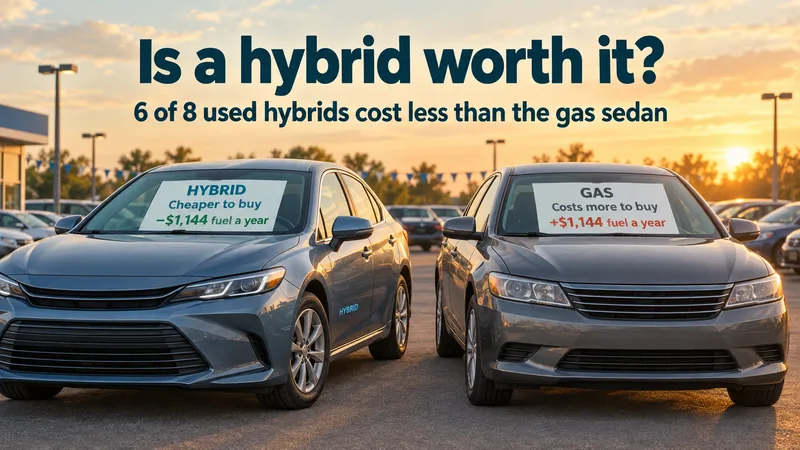
A rideshare driver is not usually buying that car. They are buying a used one, several years old, chosen across models rather than across trims of one model, and at that point the premium the question assumes has mostly stopped existing. This guide checks whether it exists in the cars this site tracks. The short version is that for six of the eight hybrids here, it does not: they are cheaper to buy and cheaper to fuel than the gas sedan on the list. There is nothing to earn back.
What the fuel gap is
The chart above is the certain half of the picture. At 30,000 miles a year and $4.085 a gallon, every hybrid on this site burns less fuel than either gas car, and the size of the gap is not a matter of opinion: it comes out of the combined MPG figure and the gas price, both of which are sourced per vehicle.
The gap runs from $97 a year at its narrowest (the Sienna against the Civic, two cars in different classes) to $3,213 at its widest, the Prius against the Odyssey. In the middle sit the numbers that matter to most drivers: a Prius, Camry Hybrid or Corolla Hybrid saves $1,144 a year against the Civic, a Niro $1,000, an Accord Hybrid $948.
Those are yearly figures at full-time mileage. Nothing about them depends on which model year you buy or what you paid for the car.
Where the premium should be, and is not
Here is the part the payback framing gets wrong. The table below puts the fuel bill next to the bottom of the used price range this site tracks for each car, sorted by fuel cost.
| Vehicle | Years | Used price from | Fuel per year | Fuel vs Civic |
|---|---|---|---|---|
| Prius | 2016-2022 | $11,360 | $2,357 | −$1,144 |
| Camry Hybrid | 2018-2024 | $13,290 | $2,357 | −$1,144 |
| Corolla Hybrid | 2020-2022 | $13,360 | $2,357 | −$1,144 |
| Niro | 2017-2022 | $8,093 | $2,501 | −$1,000 |
| Accord Hybrid | 2018-2022 | $13,250 | $2,553 | −$948 |
| Sonata Hybrid | 2020-2023 | $12,280 | $2,607 | −$894 |
| RAV4 Hybrid | 2019-2024 | $18,160 | $3,064 | −$437 |
| Sienna | 2021-2024 | $27,590 | $3,404 | −$97 |
| Civic (gas) | 2022-2025 | $16,170 | $3,501 | — |
| Odyssey (gas) | 2018-2025 | $14,228 | $5,570 | +$2,069 |
Six of the eight hybrids start below the Civic. The Niro starts $8,077 below it, the Prius $4,810 below, the Sonata Hybrid $3,890 below. A driver choosing between a used Prius and a used Civic is not paying a premium for the hybrid system and waiting to earn it back. They are paying less at the counter and less at the pump, on the same day, with no crossing point to wait for. That specific pair has its own head-to-head comparison on this site, and it reaches the same conclusion from the other direction.
Why this is not a clean measurement, and what that costs the argument
Being straight about this matters more than the headline.
This is not a same-model comparison. To measure a hybrid premium properly you compare a Camry Hybrid to a gas Camry, an Accord Hybrid to a gas Accord. This site does not track gas trims of the models it covers, so it cannot do that, and no amount of arithmetic on the table above turns it into that measurement. What the table compares is a hybrid to a different model that happens to run on gas.
The model years are not matched either, and they run in a direction that works against the hybrids on price. The Civic here is a 2022-2025 car. The Prius is 2016-2022, the Niro 2017-2022. Part of the reason those hybrids are cheaper is that they are older, not that they are hybrids. Anyone reading the $8,077 Niro gap as pure powertrain saving is reading it wrong.
So the honest version of the finding is narrower than the headline and still useful: among the cars a rideshare driver actually shops for used, the hybrids are not the expensive option. Whatever premium existed when these cars were new has been absorbed by depreciation, and what is left on the lot today is a set of hybrids that are cheaper to run and, mostly, cheaper to buy. The payback question does not have an answer here because it does not apply.
The two hybrids that do cost more are simply bigger cars
Two hybrids start above the Civic: the RAV4 Hybrid at $18,160 and the Sienna at $27,590. It would be easy to read those as the hybrid premium finally showing up, and that reading would also be wrong.
The RAV4 Hybrid is a compact SUV with 37.6 cubic feet of cargo space against the Civic’s 14.8. The Sienna is an eight-seat minivan and the only car on this site that seats more than seven. They cost more because they are more vehicle, and the thing a driver is buying with that money is space, not a powertrain. The Sienna in particular saves only $97 a year in fuel against the Civic. If you are buying it, you are buying it for the eight seats and the Uber XL tier, and the fuel economy is beside the point.
What can still go wrong
The fuel saving is close to certain. The maintenance figure is not, and it is where a hybrid can still lose.
Every maintenance number on this site is a fleet average, not a promise about the specific car in front of you. That distinction is sharper for a hybrid than for a gas car, because a hybrid carries one expensive component a gas car does not have at all: the battery pack. An out-of-warranty replacement lands on one owner’s ledger and not another’s, and an average across thousands of cars cannot tell you which one you will be. A driver who cannot absorb a four-figure surprise should weigh that differently from a driver who can, and neither this guide nor the cost-per-mile method behind it can make that call for them.
The two electric cars on this site are left out of all of the above on purpose. Their energy bill is measured in kilowatt-hours, which does not belong on the same axis as gallons, and they carry a cost this site cannot model at all: the hours spent not earning while the car charges. How the two EVs stack up against the hybrids on total cost is worked out separately, in the guide on hybrid or electric for Uber.
What to do with this
If you are choosing a used car to drive full time and you were planning to avoid hybrids because of the premium, check the actual asking prices first. In this set the premium is gone, and the fuel saving is between $894 and $1,144 a year against the gas sedan for every hybrid sedan on the list.
If you are choosing between two specific cars rather than a category, the payback calculator will take both prices and both MPG figures and tell you whether a crossing point exists and when. Often, on the used market, the answer is that it does not. The cheaper car to buy is also the cheaper car to run, and the decision is simpler than the question made it sound.