Review
Honda Civic for Rideshare: What a Non-Hybrid Costs Against This Fleet
A straightforward gas sedan whose 35 mpg costs roughly $900 to $1,150 more a year in fuel than the hybrid sedans it competes against.
- Energy 11.7¢/mi
- Maintenance 2.5¢/mi
- Depreciation 13.1¢/mi
Energy, maintenance and depreciation only, at $4.08/gal. Insurance, registration and any car payment sit on top. Add yours in the cost per mile calculator.
| Spec | Honda Civic |
|---|---|
| Combined MPG | 35 |
| kWh / 100 mi | — |
| Used price range | $16,170–$22,043 |
| Maintenance per year | $368 |
| Seats | 5 |
| Cargo (cu ft) | 14.8 |
| Rear legroom (in) | 37.4 |
| Uber X | Yes |
| Uber Comfort | No |
| Uber XL | No |
Sources: EPA fuel economy, maintenance estimates, used price guide, Uber vehicle requirements . Updated 2026-08-27.
Where the Civic wins
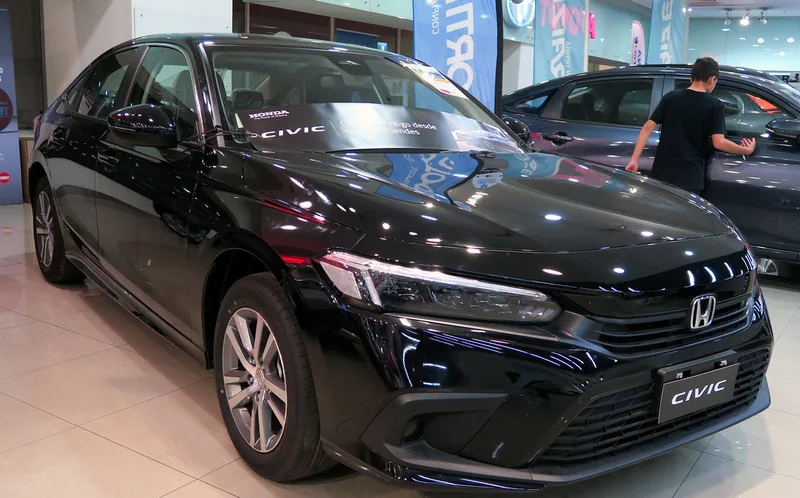
The Civic is the only pure gas car among the sedans reviewed on this site, and that has one clean advantage: no hybrid battery to ask questions about, and a maintenance rate (2.5 cents a mile) that sits in the middle of the hybrid pack rather than carrying any drivetrain complexity premium. On the 2022-2025 generation this listing covers, it is rated 35 mpg combined, and at $4.085 a gallon that works out to about 11.7 cents a mile in fuel, 2.5 cents in maintenance, and 13.1 cents in depreciation, for a 27.3-cent-a-mile total. The 76-cent IRS mileage rate still clears that real cost 2.79 times over, a solid margin even if it trails every hybrid sedan reviewed on this site.
The used-price range here is $16,170 to $22,043, a $5,873 spread. That is not the cheapest floor in this dataset, but a mid-generation Civic still undercuts several of the larger hybrids on sticker price while carrying none of their fuel-economy advantage.
Where it does not
The fuel penalty is the story with this car, and it is exact rather than approximate: at 35 mpg combined against a hybrid sedan at 47-52 mpg, the Civic burns noticeably more gas for the same mile. Annual fuel cost at 30,000 miles comes to about $3,501 against roughly $2,357 for a 52-mpg Prius or Camry Hybrid, $2,553 for the Accord Hybrid at 48 mpg, and $2,607 for the Sonata Hybrid at 47 mpg. That is a fuel-cost gap of roughly $900 to $1,150 a year against the hybrids above, and it does not close on its own; a driver logging more than 30,000 miles a year would see it widen in direct proportion to mileage.
Total running cost comes to about $8,181 a year at 30,000 miles, the highest of any sedan reviewed on this site. Even the Corolla Hybrid, whose steep depreciation gives it the second-highest total among sedans at $7,937, still comes in about $245 cheaper than the Civic, purely on the strength of the fuel-economy gap. This car is also rated Uber X only, with no Comfort eligibility, the same ceiling as the Prius and Corolla Hybrid, but without either car’s fuel-economy edge to compensate.
Passenger space and luggage
Cargo space of 14.8 cubic feet sits between the Camry Hybrid’s 15.1 and the Corolla Hybrid’s 13.1: enough for two suitcases and a bag or two, the same practical ceiling every compact-to-midsize sedan in this dataset runs into. Rear legroom of 37.4 inches is a genuine strength, trailing the Camry Hybrid’s 38.0 by only a fraction of an inch while clearing the Prius’s 33.4 and the Corolla Hybrid’s 34.8 comfortably. That is a Comfort-tier legroom number on a car that is not Comfort-eligible. Five seats mean a four-passenger ceiling, and the generous rear legroom makes the middle-seat ride better than most sedans in this dataset manage, even without the fare tier to reward it.
Maintenance costs
RepairPal’s published maintenance estimate is $368 a year, built around a typical owner’s mileage rather than a full-time driver’s. Scaled to this site’s 2.5-cent-a-mile rate, a full 30,000-mile year comes to about $750 in maintenance, roughly double the published average. That is the pattern every vehicle in this dataset shows, because a rideshare Civic covers two to three times the miles the RepairPal estimate assumes for a typical owner. Because the Civic carries a conventional drivetrain rather than a hybrid system, its maintenance profile is simpler to reason about in one sense: there is no separate battery-pack question layered on top of ordinary service, the way there is for every hybrid and EV in this dataset. That does not make the 2.5-cent rate a guarantee; it is still RepairPal’s average across whatever mix of ordinary repairs its sample includes, not a warranty for any specific car.
Does it pay for itself?
At about $8,181 a year in fuel, maintenance, and depreciation for 30,000 miles, whether the Civic pays for itself depends on fares and hours behind the wheel. Those are numbers this dataset does not track. What the figures above supply is the running-cost side of that question: 27.3 cents a mile, or the combined mpg, maintenance rate, and depreciation rate straight from the spec table, is the input a payback-period calculation needs before a purchase price in the $16,170-$22,043 range turns into a concrete number of weeks. The same figure, run through a rideshare profit calculation, turns a gross fare number into something closer to what a driver actually keeps once energy, maintenance, and depreciation are subtracted first.
On July 1 the IRS mileage rate moved from 72.5 cents in the first half of 2026 to 76 cents, a 3.5-cent step that changes nothing about what this car costs to run but adds about $1,050 to what a full 30,000-mile year is worth on a tax return compared with the earlier rate. On a car whose fuel bill already runs well above any hybrid sedan’s, that deduction offsets less of the gap than it would on a car with a smaller tank to fill.
Verdict
The Civic is a reasonable pick for a driver who wants a conventional drivetrain, generous rear legroom, and no hybrid-battery question mark, and who is willing to absorb a fuel bill running roughly $900 to $1,150 a year above the Comfort-eligible hybrid sedans in this dataset for the privilege. It is a weak pick for a driver optimizing purely on running cost, since every hybrid sedan reviewed on this site (including the Corolla Hybrid, its closest rival on price) beats it on total cost per mile. A side-by-side against the Corolla Hybrid, priced within a few thousand dollars of this car, is the natural next comparison for a driver deciding whether the hybrid premium is worth paying here.